

https://realitypathing.com/how-to-teach-children-about-the-importance-of-hymns
For many Kenyan senior school students, aural skills remain one of the biggest challenges in KCSE Music examinations. Whether it is identifying intervals, chord progressions, cadences, or rhythmic patterns, aural perception requires consistent practice, patience, and effective listening strategies. Surprisingly, one of the most powerful tools for strengthening these skills is something familiar to most of us: hymns.
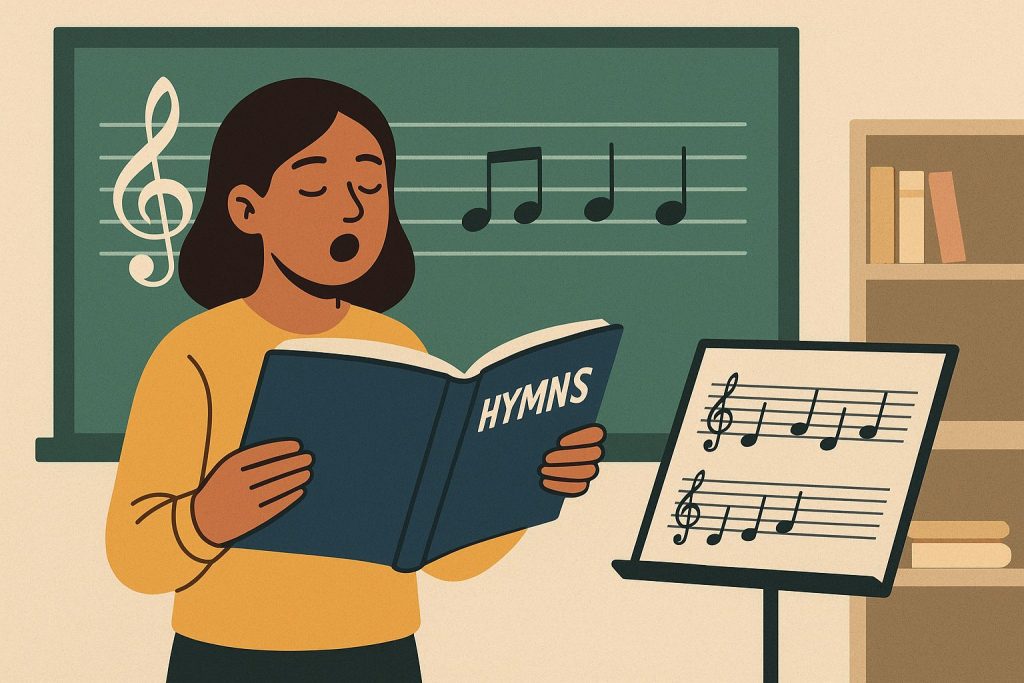
Hymns have been sung in Kenyan churches for generations—whether in SDA congregations, Catholic Mass, Anglican services, or local denominations. While they are commonly used for worship and devotion, hymns also serve as rich musical resources for training the (ear). In this article, we explore how hymns can significantly contribute to the development of aural skills and how learners can use them effectively to improve their performance in music examinations.
1. Hymns Have Clear and Strong Melodic Lines
One of the main reasons many students struggle with aural skills is that they do not spend enough time listening to simple, clear melodies. Most modern music—especially pop and Afrobeats—is rhythm-driven, repetitive, and harmonically shallow. Hymns, however, offer something different:
– Clean melodic contours
– Balanced stepwise motion
– Occasional leaps for interval training
For example, when you sing tunes like “Blessed Assurance” or “Amazing Grace,” your ear naturally learns to follow predictable melodic patterns. This helps you internalize intervals such as major 2nds, perfect 4ths, or minor 3rds—essential for KCSE aural exams.
The more you sing these melodies, the more your ear gets used to identifying pitch differences quickly and accurately.
2. Hymns Are Built on Traditional Functional Harmony
Most hymns follow standard tonal harmony using the I, IV, V, and vi chords. This makes them ideal for training the ear to recognize basic harmonic progressions. Kenyan students who struggle with identifying cadences, for instance, can learn a lot from hymn endings.
– Perfect cadences (V–I) are common in hymn conclusions.
– Plagal cadences (IV–I), famously known as the “Amen cadence,” occur frequently in church settings.
– Imperfect cadences (I–V or IV–V) often appear at the ends of phrases within stanzas.
When learners get used to hearing these cadences through regular hymn singing, identifying them in exams becomes significantly easier. Hymns expose students to real musical contexts, not just abstract theory.
3. SATB Hymnal Arrangements Train Vertical Listening
Many hymns are arranged in four-part harmony (Soprano, Alto, Tenor, Bass). Students who only sing the melody miss out on valuable aural training opportunities. When you listen to or sing in SATB harmony, your ear becomes trained to:
– Hear multiple musical lines at once
– Identify chord structures from stacked intervals
– Follow inner voices, which strengthens pitch accuracy
– Hold your part even when others are singing something different
In Kenyan secondary school choir settings, especially SDA and Catholic choirs, learners frequently encounter these harmonies. By paying close attention to how voices interact, students develop the essential aural skill of harmonic awareness, which is tested in chord identification questions.
4. Hymns Improve Rhythmic Accuracy and Listening Discipline
Many students assume that aural exams only test pitch—but rhythm is equally important. Hymns are structured using predictable rhythmic patterns, especially in common time (4/4) and triple meter (3/4).
By practicing hymn singing with attention to rhythm, students can:
– Improve their sense of timing
– Learn to clap or tap regular pulse
– Identify rhythmic motifs
– Build confidence in responding to rhythmic dictation
Traditional Kenyan hymns, such as those found in Tenzi za Rohoni and Nyimbo za Kristo, often use simple but expressive rhythms that help students internalize beat patterns naturally.
5. Hymns Encourage Repetition—The Key to Ear Training
The reason hymns are powerful learning tools is simple: repetition. In churches, families, and schools, we sing hymns repeatedly. This repetition strengthens musical memory, helping students:
– Remember melodic shapes
– Internalize tonal centers
– Recognize intervals intuitively
– Predict chord changes
Unlike classical ear-training exercises, hymns embed learning in a familiar, enjoyable context. The more often students sing them, the stronger their aural foundation becomes.
6. How Kenyan Students Can Use Hymns to Improve Aural Skills Immediately
a. Sing different parts intentionally
Try singing alto, tenor, or bass instead of soprano. This trains your ear to hear inner lines.
b. Play the melody on a piano or keyboard
Then sing the harmony part. This strengthens both pitch and harmonic hearing.
c. Solfa your favorite hymns (do–re–mi)
This helps identify scale degrees and melodic intervals.
d. Practice identifying cadences at the end of hymn phrases
Ask yourself: Is this a perfect cadence? A plagal cadence?
e. Sight-read one hymn stanza every day
Hymns are excellent sight-singing material for exam preparation.
Conclusion
For Kenyan senior school students struggling with aural exams, hymns offer an accessible, powerful, and enjoyable solution. Their strong melodies, functional harmony, SATB structure, rhythmic clarity, and repetitive nature make them perfect tools for strengthening listening skills. By incorporating hymn-singing into daily practice, students can dramatically improve their pitch recognition, harmonic awareness, rhythmic accuracy, and overall aural confidence.
Recommendation: Hymn books written in staff notation, either in closed or open score.
In short—hymns do not just inspire the spirit; they train the ear.
And for any student preparing for the KCSE Music aural paper, this is a gift worth embracing.
More Stories
Music, Time, and the Sound of New Beginnings
? Did You Know? The Piano Was Invented to Play Soft and Loud
? Did You Know? The Tritone Was Once Called “The Devil in Music”