


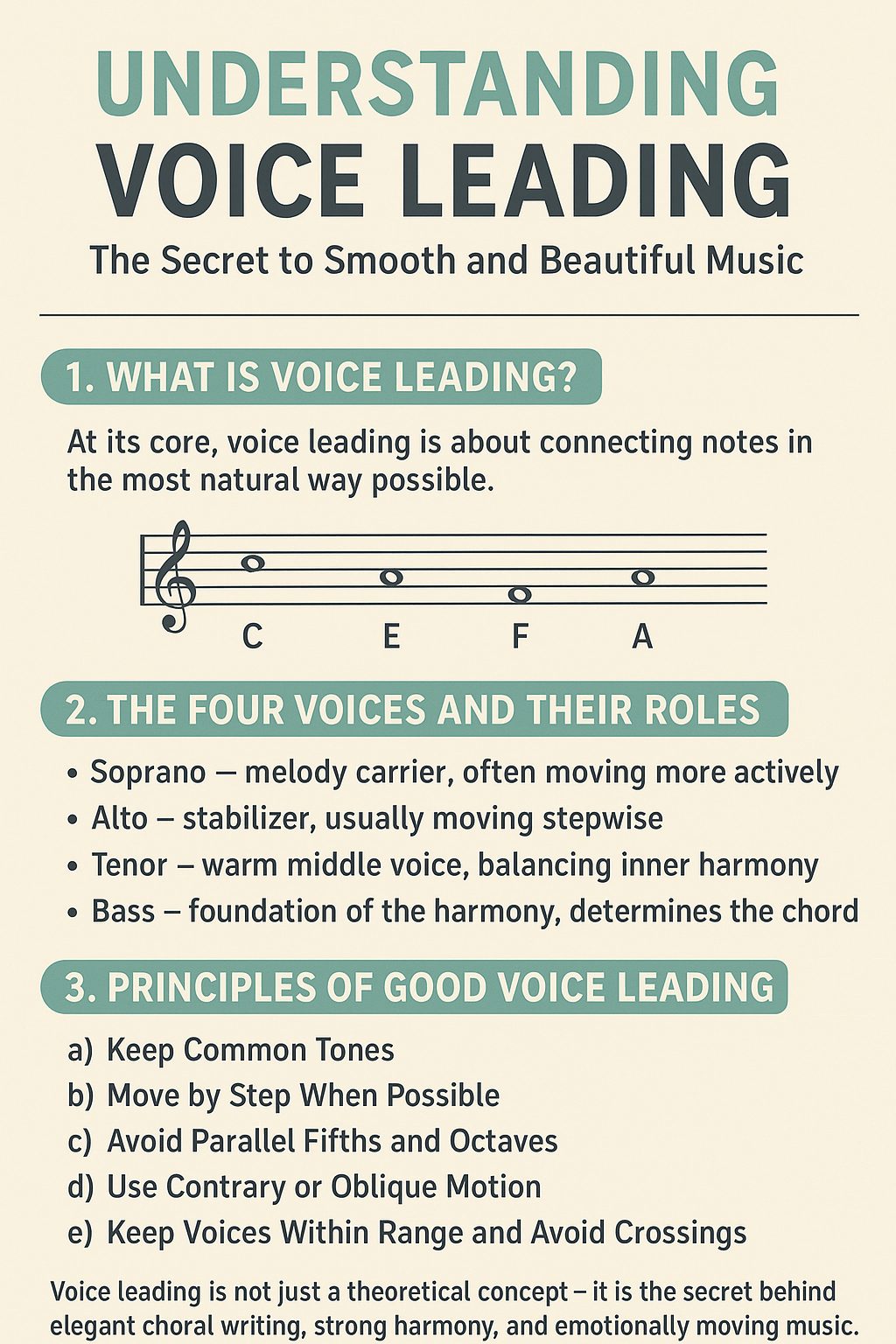
Voice leading is one of the most important concepts in music theory, especially for anyone working with choral music, classical harmony, or SATB arrangements. It refers to the way individual melodic lines (voices) move from one note or chord to another. When done well, voice leading creates smooth, expressive, and satisfying music. When ignored, even a good chord progression can sound rough, confusing, or unstable.
Although voice leading developed strongly during the Common Practice Period (1600–1900), its principles remain essential today—from choir arrangements to film music and even pop harmonies. We explore what voice leading really means, why it matters, and how you can apply it in your own musical work.
1. What Is Voice Leading?
At its core, voice leading is about connecting notes in the most natural way possible. Imagine each voice in a choir as a singer walking on a path. The smoothest path is the one with the least unnecessary movement. Instead of jumping up and down, voices should move step wise (by whole steps or semitones) or through small intervals whenever possible.
Voice leading has two goals:
1. Maintain melodic beauty in each individual voice..
2. Ensure harmonic clarity when voices combine.
This means each line should sound singable on its own, and when combined with others, the chords should flow logically.
2. The Four Voices and Their Roles
Traditional voice leading uses four SATB voices:
Soprano – melody carrier, often moving more actively
Alto – stabilizer, usually moving stepwise
Tenor – warm middle voice, balancing inner harmony
Bass – foundation of the harmony, determines the chord
Understanding these roles helps you decide how far a voice can leap, when to use steps, and how each part contributes to the overall sound.
3. Principles of Good Voice Leading
a) Keep Common Tones
When moving from one chord to another, keep any notes that appear in both chords in the same voice.
For example, in a I → IV progression (C major to F major), the note C appears in both chords. Keeping a common tone creates stability and smoothness.
b) Move by Step When Possible
Stepwise motion is the heart of good voice leading. If a voice can move from one note to the next using a small step instead of a leap, choose the smaller interval. This creates a natural melodic line and reduces tension.
c) Avoid Parallel Fifths and Octaves
This is one of the most famous rules in harmony.
When two voices move in the same direction by the same interval to form a perfect 5th or 8ve, their independence disappears. For choral music, this makes the parts sound merged, and the texture becomes weaker.
d) Use Contrary or Oblique Motion
Contrary motion (voices moving in opposite directions) is particularly strong because it gives clarity and independence.
Example: The bass moves down while the soprano moves up.
Oblique motion (one voice stays while the other moves) is also effective and stable.
e) Keep Voices Within Range and Avoid Crossings
Each part should stay in its normal vocal range—not too high, not too low. Voice crossing (when a lower part rises above a higher part) should be avoided, as it confuses the texture. For instance, the alto should not sing above the soprano.
f) Use Smooth Bass Lines
The bass line controls the harmony. A smooth, step wise bass makes the entire chord progression feel grounded and predictable. This is why many hymns and chorales use mostly step wise bass motion.
4. Why Voice Leading Matters
a) Better Choral Blend
When each part moves smoothly, singers find it easier to maintain pitch, breath support, and blend. Good voice leading reduces strain and improves tonal unity.
b) Clearer Harmony
Even the strongest chord progression can sound muddy if the voices jump randomly. Proper voice leading ensures that chords sound balanced and complete.
c) Easier Learning for Choirs
Singers remember logical, flowing lines more easily than awkward leaps. This is especially important for school choirs and church groups who rehearse under time constraints.
d) More Expressive Music
Voice leading controls musical tension and release. Stepwise motion, suspensions, resolutions, and contrary motion all help shape emotional expression.
5. Practical Tips for Composers and Arrangers
Start by writing the bass and soprano lines; they define the outer structure.
Fill in the alto and tenor with smooth, small movements.
Avoid repeating the same chord shape in all voices—introduce subtle motion.
Use passing tones, suspensions, and neighbor tones to create interest.
Always check for hidden parallels—especially between soprano and bass.
Sing each part individually. If a line is difficult to sing, revise it.
Conclusion
Voice leading is not just a theoretical concept—it is the secret behind elegant choral writing, strong harmony, and emotionally moving music. Whether you are arranging an SDA hymn, writing for your choir, or studying classical harmony, mastering voice leading will transform the sound of your music.
When voices move logically and smoothly, the listener experiences clarity, beauty, and comfort. And for musicians, it opens the door to more sophisticated composition and enjoyable performance.

More Stories
Music, Time, and the Sound of New Beginnings
? Did You Know? The Piano Was Invented to Play Soft and Loud
? Did You Know? The Tritone Was Once Called “The Devil in Music”