

Did you know that one musical interval was once considered so dangerous that musicians were warned to avoid it?
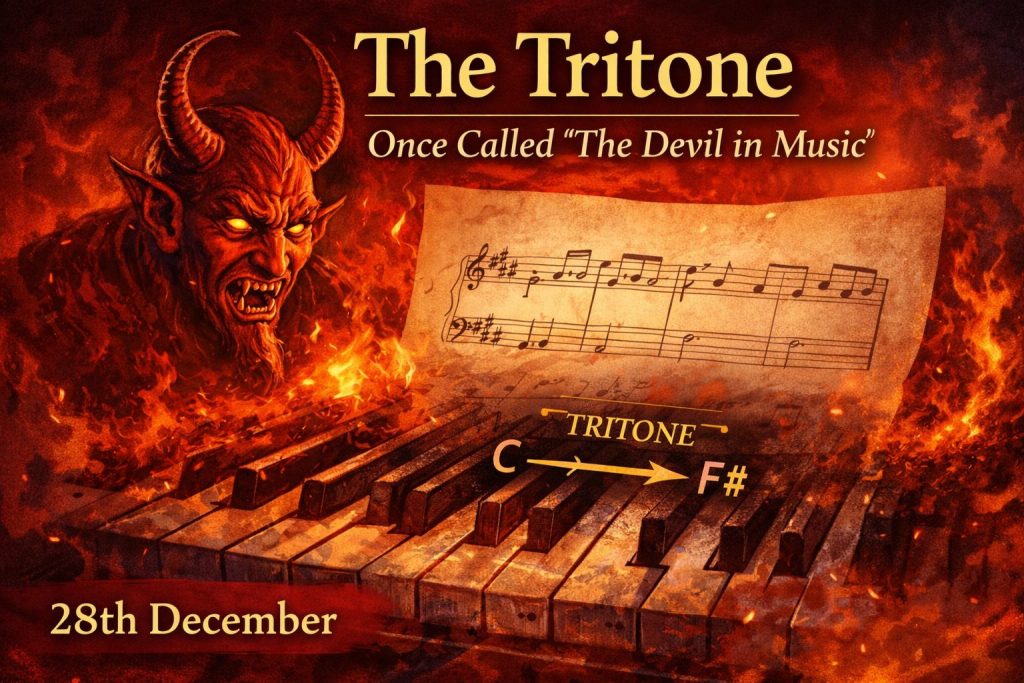
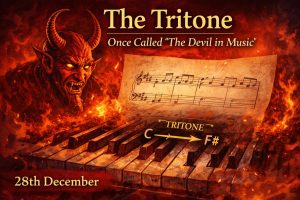
In the Middle Ages, the tritone—an interval spanning three whole tones—earned a chilling nickname: Diabolus in Musica, meaning “the Devil in music.” Today, this same interval is widely used in jazz, film scores, blues, and even church music. But for centuries, it was feared, misunderstood, and sometimes forbidden.
https://www.classical-music.com/features/musical-terms/tritone
What Exactly Is a Tritone?
In simple terms, a tritone is the interval between two notes that are three whole steps apart. For example:
C to F♯
B to F
E to B♭
It sits exactly halfway between an octave and creates a sound that feels unstable, tense, and unresolved. Unlike a perfect fifth or octave—which sounds settled—the tritone demands movement. It wants to go somewhere.
This very tension is what made it both fascinating and frightening.
https://en.wikipedia.org/wiki/Tritone
Why Was the Tritone Feared?
During the medieval period, Western music was closely tied to the church. Music was expected to reflect order, purity, and divine harmony. Intervals like octaves, fifths, and fourths were considered “perfect” because of their mathematical simplicity and pleasing sound.
The tritone, however, broke these expectations. It sounded harsh, clashing, and unsettling—especially when sung without instrumental support. In an era without modern tuning systems, the tritone could sound even more unstable than it does today.
As a result, it became associated with chaos, temptation, and evil, earning its infamous title.
While there is debate among scholars about whether the interval was officially “banned,” it was certainly discouraged in theory and practice, especially in sacred music.
https://www.britannica.com/art/tritone
The Tritone and Music Theory
From a theoretical perspective, the tritone is powerful because it divides the octave symmetrically. This symmetry removes a clear tonal center, making listeners feel suspended.
Later, composers learned to control and resolve this tension. In tonal harmony, the tritone is at the heart of the dominant seventh chord, which naturally resolves to the tonic. This discovery transformed the tritone from a problem into a tool.
What was once feared became foundational.
From Fear to Expression
By the Renaissance and Baroque periods, composers began using the tritone deliberately for dramatic and expressive purposes. By the time of Bach, it was no longer taboo—it was essential.
Fast forward to the 19th and 20th centuries, and the tritone found new life:
Jazz musicians embraced it for its color and edge
Blues used it to create emotional grit
Film composers used it to signal danger, mystery, or evil
Modern worship and choral music use it carefully for tension and release
Ironically, the very sound once labeled “devilish” became one of music’s most expressive tools.
A Sound That Tells a Story
The tritone teaches us something important about music—and about people.
What sounds uncomfortable at first can later be understood, embraced, and even celebrated. As listeners evolved, so did composers’ ability to guide the ear through tension toward resolution.
In many ways, the tritone mirrors life itself: conflict is not the end—it is often the beginning of growth.
Why This Matters Today
For students of music theory, the tritone is a key that unlocks harmony, modulation, and expressive writing. For performers, understanding its pull helps shape phrasing and interpretation. For listeners, it explains why certain moments in music feel unsettling—or thrilling.
The tritone reminds us that music is not only about beauty, but also about emotion, contrast, and meaning.
Final Thought
The next time you hear a suspenseful film score, a jazzy chord, or a hymn that briefly unsettles before resolving, listen closely. You may be hearing the echo of an interval once feared across medieval cathedrals.
From “the Devil in music” to a cornerstone of harmony, the tritone’s journey proves one timeless truth:
Music evolves—but its power to move us never fades.
More Stories
Music, Time, and the Sound of New Beginnings
? Did You Know? The Piano Was Invented to Play Soft and Loud
? Did You Know? The World’s Oldest Known Melody Is Over 3,400 Years Old