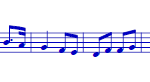


Did you know that the oldest known melody in the world is more than 3,400 years old—and we can still sing it today?
Long before Bach, Beethoven, or even Gregorian chant, humans were already writing down music. One remarkable discovery has given modern musicians a rare opportunity to hear what ancient music may have sounded like.
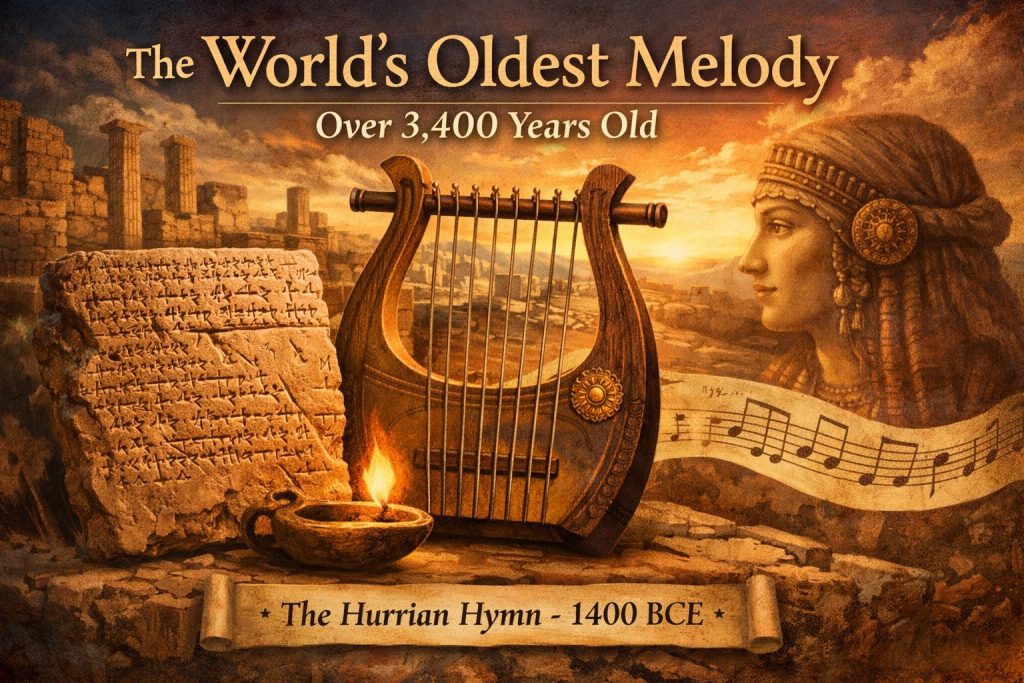
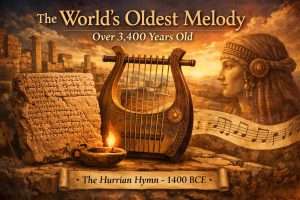
The Hurrian Hymn No. 6
In the 1950s, archaeologists excavating the ancient city of Ugarit (modern-day Syria) discovered a set of clay tablets written in cuneiform script. Among them was what we now call Hurrian Hymn No. 6, dated to around 1400 BCE.
This hymn was dedicated to Nikkal, the goddess of orchards in Hurrian culture. What makes it extraordinary is that it contains both lyrics and musical instructions, making it the oldest known example of written music in human history.
How Was Ancient Music Written?
Unlike modern musical notation with staffs and notes, the Hurrian hymn uses a numeric and interval-based system. The tablet describes:
The tuning of a stringed instrument (likely a lyre)
Interval relationships between strings
Instructions for performance
Scholars believe the system was based on heptatonic scales (seven-note scales), showing that ancient musicians already had a sophisticated understanding of pitch organization.
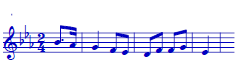
Reconstructing the melody hasn’t been easy. Different musicologists have produced slightly different versions, but all agree on one thing: this was real, intentional music, not just poetic chanting.
What Did It Sound Like?
When reconstructed and performed today, the Hurrian Hymn sounds surprisingly familiar—yet hauntingly ancient. It resembles:
Early modal music
Middle Eastern melodic patterns
Simple hymn-like structures
There is no harmony as we know it today, but the melodic contour feels intentional and expressive. This reminds us that music has always been about emotion, worship, and communication, regardless of the era.
Music and Worship: A Timeless Connection
One fascinating aspect of the Hurrian Hymn is its religious purpose. Just like the Psalms of David or early Christian hymns, this ancient melody was written as an act of worship.
Across civilizations—Mesopotamian, Hebrew, Greek, African, and beyond—music has always played a central role in spiritual life. This continuity highlights a powerful truth: music is woven into the human search for meaning and connection with the divine.
Why This Matters Today
Understanding ancient music changes how we see our modern musical world. It tells us that:
Music theory didn’t appear suddenly—it evolved over thousands of years
Scales, tuning systems, and notation are human inventions shaped by culture
Music is one of humanity’s oldest intellectual and artistic achievements
For composers, performers, and music students, this discovery is humbling. Every melody we sing today stands on the shoulders of countless generations who sang before us.
A Living Sound from the Ancient World
Perhaps the most amazing thing about the Hurrian Hymn is that it is not silent history. Unlike ruins or artifacts behind glass, this piece can still be performed, heard, and felt.
When modern musicians bring this hymn to life, they bridge a gap of more than three millennia—reminding us that while technology and societies change, the human love for music remains constant.
Final Thought
The next time you hear a simple melody or hymn, remember this: humans have been doing this for thousands of years. Long before written books, recorded sound, or digital music, people were already composing, worshipping, and expressing themselves through organized sound.
Music is ancient. Music is human. Music endures.
More Stories
Music, Time, and the Sound of New Beginnings
? Did You Know? The Piano Was Invented to Play Soft and Loud
? Did You Know? The Tritone Was Once Called “The Devil in Music”