

? Did You Know?
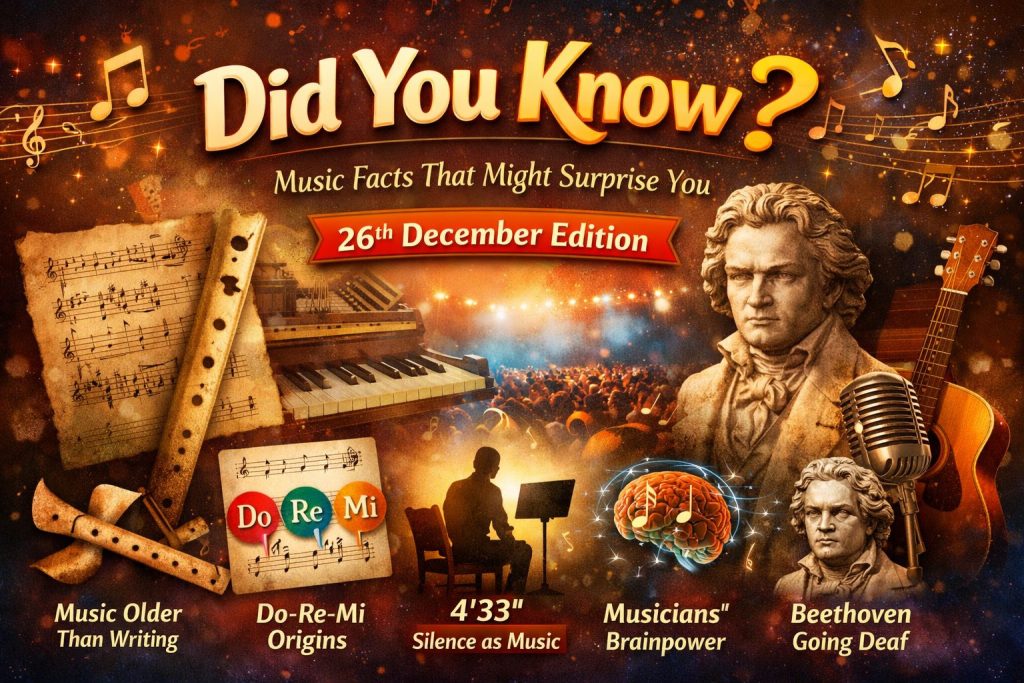
Music surrounds us so completely that it often feels timeless and inevitable—yet behind even the most familiar sounds lie stories that are surprising, clever, and sometimes unbelievable. Today’s Did You Know? explores fascinating musical facts that stretch across history, theory, instruments, and everyday listening. Whether you’re a trained musician or a casual listener, these insights may change how you hear music.
? 1. Did you know that music existed before written language?
Long before humans developed writing systems, music was already part of daily life. Archaeologists have discovered bone flutes dating back over 40,000 years, some made from bird bones and mammoth ivory. These instruments suggest that early humans not only communicated musically but also understood pitch relationships and scales.
This tells us something profound: music is not an “extra” human activity—it is fundamental. Singing, drumming, and dancing likely played roles in ritual, storytelling, bonding, and survival long before words were written down.
https://www.sciencefocus.com/the-human-body/when-did-humans-first-make-music
? 2. Did you know that the modern piano was once considered too loud?
When Bartolomeo Cristofori invented the piano around 1700, musicians were skeptical. Unlike the harpsichord, which had a consistent volume, the piano allowed players to control dynamics—soft (piano) and loud (forte). Many musicians felt this expressive power was unnecessary or even distracting.
Ironically, that very feature is why the piano became one of the most important instruments in Western music, capable of whispering intimacy or thunderous power—all from the same keyboard.
? 3. Did you know that the “Do-Re-Mi” system comes from a hymn?
The solfège syllables Do, Re, Mi, Fa, Sol, La, Ti were developed in the 11th century by Guido of Arezzo, a medieval music theorist. He borrowed them from the opening syllables of each line of a Latin hymn, Ut Queant Laxis.
Originally, “Do” was “Ut,” but it was later changed because “Do” was easier to sing. This system revolutionized music education, making sight-singing and teaching far more efficient—a method still used worldwide today.
https://en.wikipedia.org/wiki/Solf%C3%A8ge
? 4. Did you know that silence is officially part of music?
One of the most famous (and controversial) pieces in music history is John Cage’s 4’33”, composed in 1952. In this piece, the performer does not intentionally play any notes for four minutes and thirty-three seconds.
Yet, the music is not “nothing.” The audience hears coughs, shuffling, wind, breathing—unplanned sounds that become the performance. Cage’s work reminds us that music is not only about sound, but about listening.
? 5. Did you know that musicians’ brains are physically different?
Scientific studies show that musicians often have a larger corpus callosum, the structure that connects the left and right hemispheres of the brain. This means musicians process information more efficiently between analytical and creative centers.
Early musical training is also linked to improved memory, language skills, coordination, and emotional sensitivity. In short, music doesn’t just train the ear—it reshapes the brain.
? 6. Did you know that singing together synchronizes hearts?
When people sing together—especially in choirs—their heartbeats and breathing patterns begin to synchronize. This phenomenon has been observed in choral settings and explains why communal singing feels deeply bonding and emotionally powerful.
This may help explain why music plays such a strong role in worship, protests, celebrations, and national identity. Music literally brings people “into one rhythm.”
? 7. Did you know that some instruments were banned in churches?
At various points in history, instruments like drums, violins, and even organs were considered inappropriate for worship. Drums were often associated with pagan rituals, while violins were linked to dance and entertainment.
Today, many churches embrace a wide range of instruments—but this history reminds us that musical acceptance is often shaped more by culture than by theology.
? 8. Did you know that Beethoven composed while going deaf?
Ludwig van Beethoven began losing his hearing in his late 20s and was almost completely deaf by the time he composed some of his greatest works, including the Ninth Symphony.
He felt vibrations through the piano and imagined sound internally. His story stands as one of the most powerful examples of human resilience and creative imagination in music history.
https://www.britannica.com/biography/Ludwig-van-Beethoven/Approaching-deafness
? Final Thought
Music is far more than entertainment. It is ancient, scientific, emotional, spiritual, and deeply human. Every note carries history; every silence carries meaning. As we continue this daily Did You Know? journey, remember: the more you learn about music, the more richly you hear it.
More Stories
Music, Time, and the Sound of New Beginnings
? Did You Know? The Piano Was Invented to Play Soft and Loud
? Did You Know? The Tritone Was Once Called “The Devil in Music”